Strategic management in 2026 is no longer about writing five-year plans and hoping the market cooperates. Today’s business environment is shaped by artificial intelligence, geopolitical shifts, digital disruption, and rapidly changing customer behavior. I’ve seen how companies that once dominated their industries collapsed simply because they failed to adapt their strategy in time.
The reality is clear: strategy today must be flexible, data-driven, and deeply connected to execution. This article explores how successful organizations plan, implement, and refine their strategies in 2026. You’ll learn how modern leaders use analytics, agile frameworks, and cross-functional alignment to stay competitive. If you want your business to grow sustainably in an unpredictable world, understanding strategic management in 2026 is no longer optional — it’s essential.
Table of Contents
Why Strategic Management Has Changed in 2026
The traditional approach to strategy was built for stable markets and predictable competitors. In 2026, neither exists. I’ve observed how digital platforms, global startups, and AI-powered tools can disrupt entire industries within months. Competitive advantages now expire quickly.
Organizations must respond faster, experiment more, and revise plans continuously. Customers expect personalization, speed, and transparency. Regulators respond rapidly to new technologies. Supply chains are vulnerable to geopolitical and climate risks. These forces demand a new form of strategic management — one that prioritizes learning, resilience, and rapid adaptation over rigid planning.
Strategy in a Volatile World
Modern strategy focuses on responsiveness rather than prediction. Companies succeed by adapting faster than competitors, not by forecasting perfectly.
From Static Plans to Adaptive Strategy Models
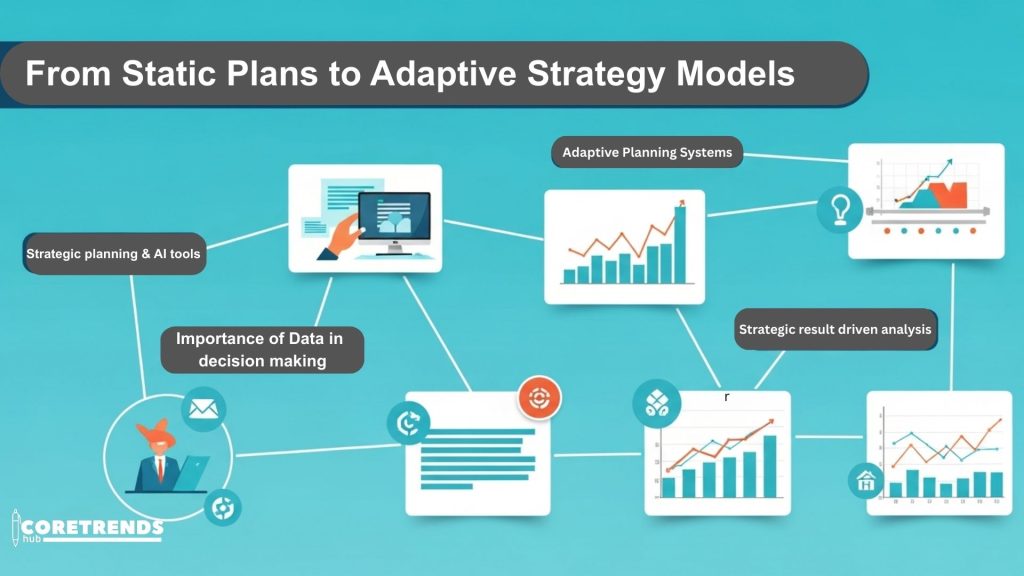
In 2026, successful companies no longer rely on fixed annual strategy documents. I’ve seen organizations replace them with adaptive planning systems that evolve quarterly or even monthly. These systems combine scenario analysis, rapid experimentation, and real-time feedback.
Adaptive strategy allows leaders to test ideas quickly, measure impact, and scale what works. It also reduces fear of failure, encouraging innovation. Instead of committing fully to uncertain initiatives, companies invest in small experiments first. This approach minimizes risk while maximizing learning. Strategy becomes a living process, not a static document.
Why Flexibility Beats Perfection
Perfect plans rarely survive first contact with reality. Flexible strategies outperform rigid ones in dynamic markets.
The Role of Data and AI in Strategic Decision-Making
Data has become the foundation of modern strategy. In 2026, I see executives relying heavily on predictive analytics, customer behavior modeling, and AI-powered forecasting. These tools reveal patterns that humans often miss and enable faster responses.
However, data alone is not strategy. Successful leaders combine analytics with experience and ethical judgment. AI can identify trends, but humans decide priorities. According to research by McKinsey, organizations that integrate analytics into strategic planning consistently outperform competitors.
reference: https://www.mckinsey.com
Turning Insights into Action
Data creates value only when leaders translate insights into timely decisions and operational changes.
Aligning Strategy with Company Culture
One of the biggest strategic failures I’ve observed is misalignment between plans and culture. Even the best strategy fails if employees don’t believe in it or understand it. In 2026, culture is a strategic asset, not a soft concept.
High-performing organizations embed strategy into daily routines, incentives, and leadership behavior. They communicate priorities clearly and reinforce them through recognition and development. When culture supports strategy, execution accelerates. When it doesn’t, resistance and confusion slow progress.
Culture as a Competitive Advantage
Strong cultures amplify strategy by aligning behavior with organizational goals.
Execution: Turning Vision into Results
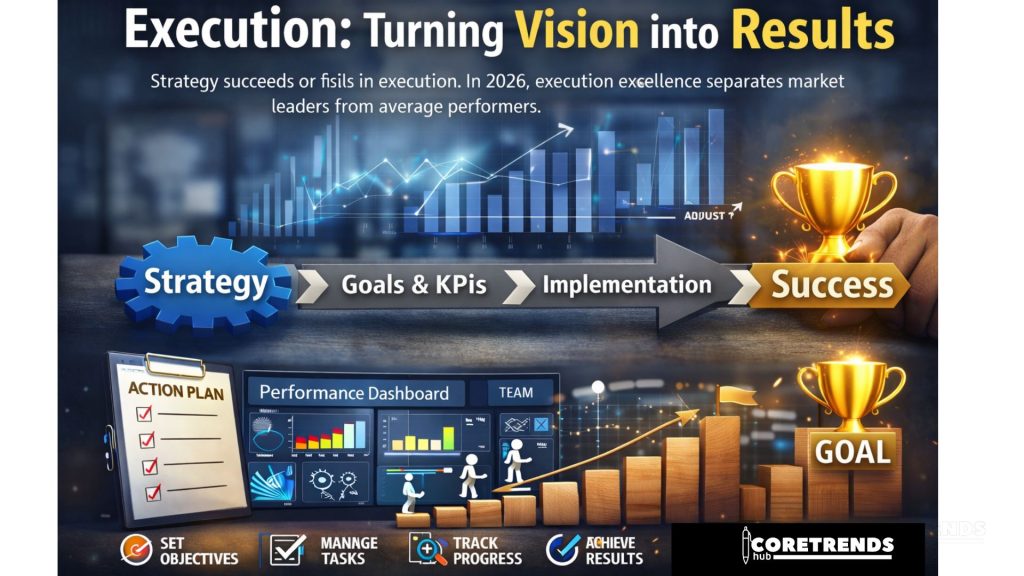
Strategy succeeds or fails in execution. I’ve seen many organizations invest heavily in planning but neglect implementation. In 2026, execution excellence separates market leaders from average performers.
Top companies translate strategy into measurable objectives, departmental goals, and individual responsibilities. They use dashboards, performance reviews, and project management systems to track progress. Regular feedback loops ensure rapid correction. Execution is not a final step — it’s an ongoing management discipline that requires constant attention.
Closing the Strategy–Execution Gap
Clear accountability and transparent metrics prevent strategies from dying at the operational level.
Managing Risk and Uncertainty Strategically
Uncertainty is no longer an exception — it’s the norm. In 2026, strategic management must include structured risk assessment and resilience planning. I’ve seen companies integrate geopolitical analysis, cybersecurity planning, and climate risk into their strategies.
Scenario planning helps leaders prepare for multiple futures. Diversified supply chains reduce dependency. Financial buffers protect against shocks. Instead of avoiding risk, modern strategy manages it intelligently. Resilient organizations treat uncertainty as a design constraint rather than a threat.
Resilience as Strategy
Prepared organizations recover faster and gain market share during crises.
Building Sustainable Competitive Advantage in 2026
Competitive advantage in 2026 is built on capabilities, not products. I’ve observed that leading companies invest in data infrastructure, talent development, customer experience, and innovation systems. These capabilities are difficult to replicate.
Technology alone is not enough. What matters is how effectively it is integrated into processes and culture. Companies that continuously improve their core competencies stay ahead even as markets evolve. Sustainable advantage comes from learning faster than competitors.
Capabilities Over Products
Products can be copied. Organizational capabilities create long-term differentiation.
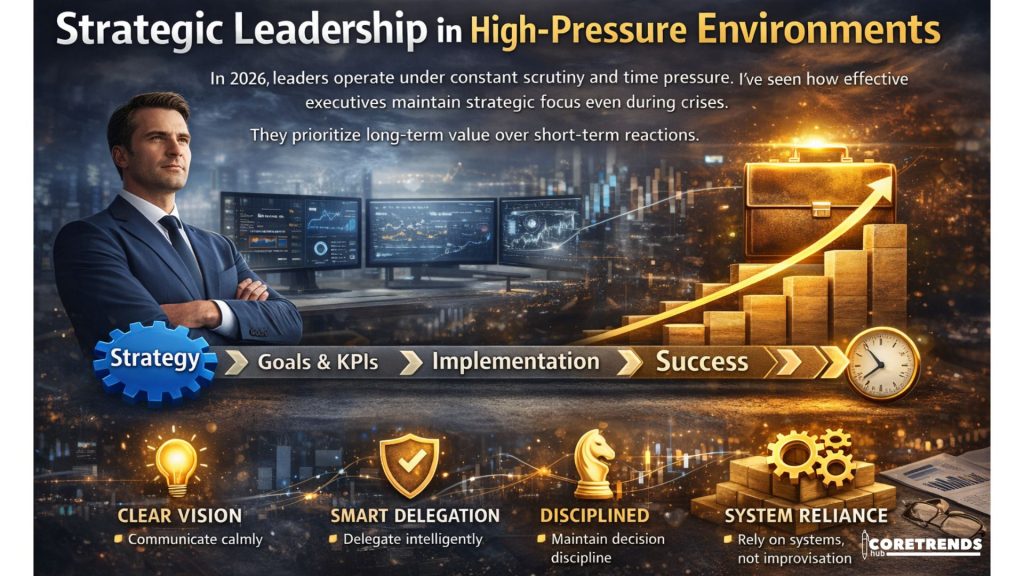
Strategic Leadership in High-Pressure Environments
In 2026, leaders operate under constant scrutiny and time pressure. I’ve seen how effective executives maintain strategic focus even during crises. They prioritize long-term value over short-term reactions.
Strategic leaders communicate calmly, delegate intelligently, and maintain decision discipline. They avoid reactive management and preserve organizational stability. Under pressure, they rely on systems rather than improvisation. This stability builds confidence across the organization.
Leading Through Complexity
Strong systems allow leaders to think strategically even in turbulent conditions.
Conclusion
Strategic management in 2026 is defined by adaptability, integration, and execution excellence. I’ve seen that companies win not because they predict the future perfectly, but because they respond faster and learn continuously. Data, AI, culture, and leadership now operate as interconnected systems rather than separate functions.
Successful organizations align vision with daily operations, balance innovation with discipline, and treat uncertainty as a design factor. Strategy today is not a document — it is a living process. Leaders who embrace this reality build resilient, competitive, and sustainable enterprises. In a world of constant change, strategic management is no longer about planning for stability — it’s about mastering transformation.
Frequently Asked Questions (FAQ)
Q1: Is long-term planning still relevant in 2026?
Yes, but it must be flexible and continuously updated.
Q2: How often should companies review strategy?
At least quarterly, with ongoing monitoring.
Q3: Does AI replace strategic thinking?
No. AI supports analysis, but humans define direction.
Q4: What causes most strategy failures?
Poor execution and cultural misalignment.
Q5: Can small businesses apply these principles?
Yes. Adaptive planning benefits organizations of all sizes.