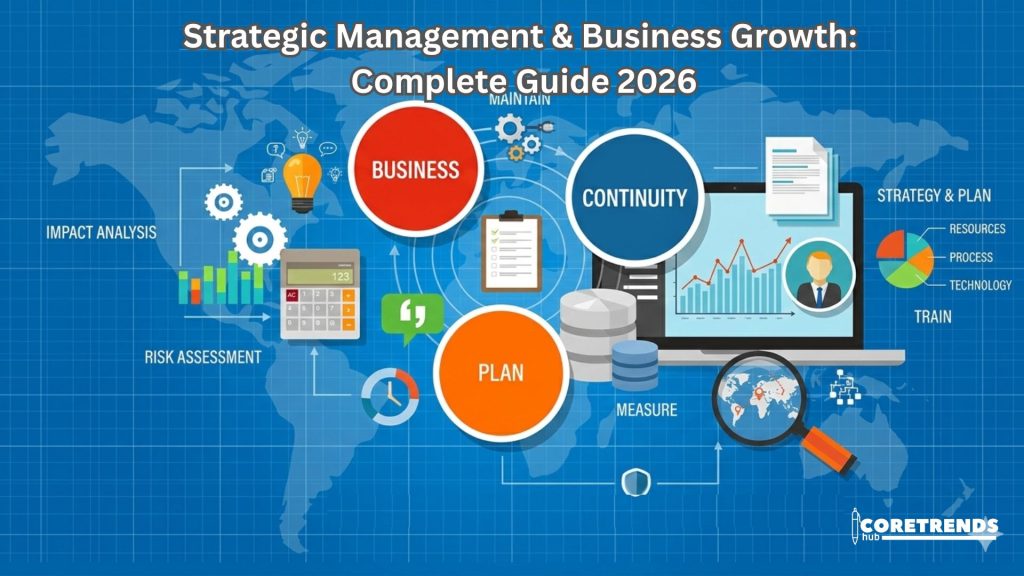
There’s a moment that arrives in every business journey—sometimes quietly, sometimes with the force of a wake-up call—when you realize that working harder isn’t the answer anymore. You’re putting in the hours, your team is hustling, the products are solid, yet growth has plateaued or worse, you’re watching competitors surge ahead while you’re stuck in operational quicksand. This is the moment when strategic management stops being business school jargon and becomes the difference between thriving and merely surviving. Strategic management isn’t about creating impressive PowerPoint decks that gather dust after the annual planning retreat. It’s the living, breathing discipline of making deliberate choices about where your business is going, how it will get there, and what it needs to become along the way. In 2026, as artificial intelligence reshapes industries overnight, geopolitical tensions redraw market boundaries, and customer expectations evolve at unprecedented speed, strategic management has transformed from a competitive advantage into an existential necessity. This comprehensive guide takes you beyond theory into the practical reality of building strategy that works—not just on paper, but in the messy, unpredictable world where your business actually operates. Whether you’re leading a startup finding its footing, a growing company hitting its first scaling challenges, or an established business navigating transformation, the principles and frameworks here provide the foundation for sustainable, intentional growth.
Table of Contents
The Strategic Management Revolution: Why Everything Changed
Strategic management once meant five-year plans developed by executives in closed-door sessions, handed down to employees expected to execute without question. That world is gone, swept away by the velocity of change that defines modern business. The half-life of competitive advantage has collapsed—what differentiated you last year may be irrelevant today, and what works today could be obsolete by next quarter. Technology that seemed futuristic eighteen months ago is now table stakes, customer loyalty that took decades to build can evaporate with a single viral social media thread, and business models that appeared unshakeable crumble when nimble competitors rewrite the rules. Yet paradoxically, this environment makes strategic management more valuable, not less. When everything is changing, the ability to maintain strategic clarity while remaining operationally flexible becomes your anchor in the storm. The companies winning in 2026 share a common characteristic: they’ve mastered the art of strategic agility—holding firm to core purpose and values while adapting tactics and approaches continuously based on what they learn. They don’t mistake activity for progress or busyness for effectiveness. They make conscious choices about what not to do, understanding that strategy is as much about deliberate exclusion as ambitious inclusion. They build organizations where strategy isn’t something executives do to the business annually, but something the entire organization practices daily through thousands of decisions aligned toward common objectives. This isn’t your grandfather’s strategic planning—it’s something more dynamic, more distributed, and infinitely more powerful.
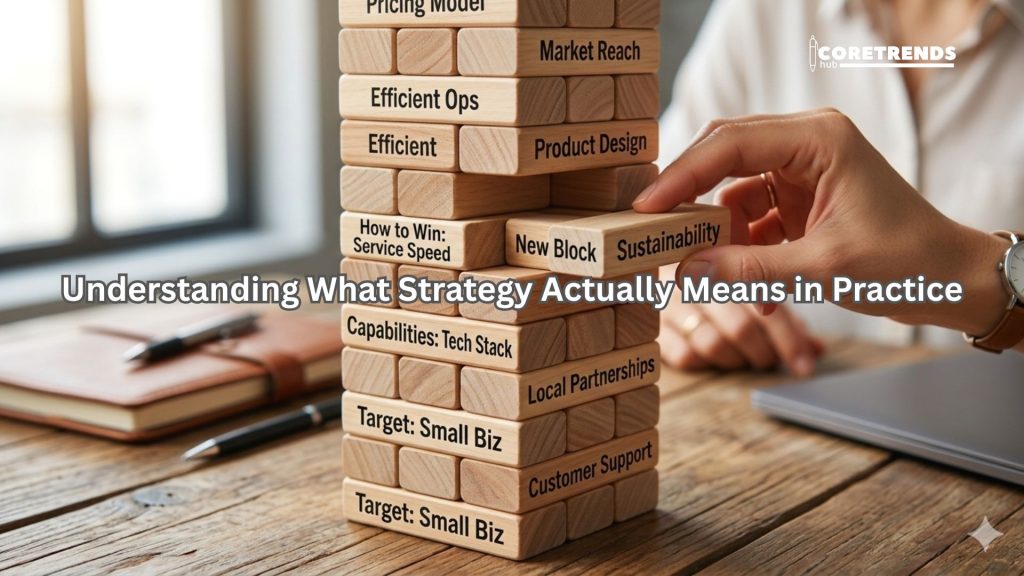
Understanding What Strategy Actually Means in Practice
Strategy has become one of those words used so broadly it risks meaning nothing at all. Marketing strategies, sales strategies, social media strategies, hiring strategies—everything gets called strategy whether it deserves the label or not. Real strategy, the kind that transforms businesses and creates lasting competitive advantage, is something more specific and more profound. Strategy is the integrated set of choices you make about where to compete, how to win in those arenas, and what capabilities you need to build to make winning sustainable. It’s the bridge connecting your current reality to your desired future, but unlike a physical bridge, this one must be rebuilt continuously as circumstances evolve. Your strategy answers fundamental questions that every business faces: What customer needs will we serve, and which ones will we deliberately ignore? What makes us different enough that customers choose us over alternatives, including the alternative of doing nothing? How will we create value that we can capture profitably over time? What capabilities must we develop to deliver on our promises consistently? How will we allocate our always-limited resources of time, money, and attention? These aren’t abstract philosophical questions—they’re brutally practical choices with real consequences. Getting them right doesn’t guarantee success, but getting them wrong virtually guarantees painful struggles regardless of how hard you work or how talented your team is. The businesses that excel at strategy demonstrate three consistent characteristics: they have remarkable clarity about what they’re trying to accomplish and why it matters, they maintain disciplined focus on their strategic priorities even when attractive distractions appear, and they build organizational systems that translate strategic intent into operational reality.
The Strategic Framework That Actually Works
Frameworks provide structure without dictating answers—they guide thinking without constraining creativity. The most effective strategic management framework for 2026 balances analytical rigor with creative imagination, combining outside-in market perspective with inside-out capability assessment. Start with brutal honesty about your current position. Where do you actually stand today, not where you wish you stood or where your marketing claims you stand? What are your genuine competitive advantages—the things you do meaningfully better than alternatives, proven by customer behavior rather than internal opinion? What are your honest weaknesses that competitors exploit or that limit your growth? This requires psychological safety where inconvenient truths can be spoken without career consequences, because self-deception about your starting point dooms every subsequent strategic choice. Next, develop deep understanding of the external environment shaping your opportunities and constraints. What are customers truly hiring your product or service to accomplish in their lives? How are their needs evolving, and what shifts do they anticipate in the next one to three years? Who are your real competitors—not just the obvious direct competitors, but the substitutes and alternatives that solve customer problems differently? What technological, regulatory, economic, and social forces are reshaping your industry’s landscape? This outside-in perspective prevents the dangerous insularity where companies become fascinated by their own ideas while missing market reality. The strategic choices emerge from this understanding: where will you compete, with what offering, creating value how, and delivered through what business model? These choices must be coherent—each element should reinforce the others rather than pointing in contradictory directions. Finally, translate these strategic choices into the operational capabilities, organizational structures, and cultural norms that make them real. Strategy execution isn’t a separate phase that follows strategy development; it’s integral to the strategic work itself.
Building Strategy That Connects Vision to Execution
The graveyard of failed strategies is filled with brilliant visions that never translated into changed behavior. The gap between strategy and execution has killed more good ideas than bad competition ever has. Bridging this gap requires treating execution not as implementation of a predetermined plan, but as the organizational capability to adapt intelligently while maintaining strategic direction. Start by ensuring your strategy is actually understandable. If your team can’t explain your strategy clearly to their colleagues, it’s not a communication problem—it’s a strategy problem. Simplicity doesn’t mean simple-minded; it means distilled to essential choices that guide daily decisions. Your strategy should answer the practical question your middle manager has on Tuesday afternoon: should we invest resources in this opportunity or that one? Netflix’s strategy of becoming the best global entertainment distribution network through technology and original content provides clear guidance for thousands of decisions without specifying every tactical choice. Once your strategy is clear, cascade it through your organization not through PowerPoint presentations but through the operating mechanisms that run your business. How do budgets get allocated? What gets measured and reviewed? Who gets promoted and why? What projects get greenlit and which get killed? These operating rhythms embed strategy into organizational DNA far more effectively than inspiring speeches at company all-hands meetings. Create feedback loops that surface what’s working and what isn’t quickly enough to adjust. Strategy isn’t about predicting the future accurately—it’s about learning faster than the environment changes. Companies like Amazon institutionalize mechanisms forcing strategic review even of successful initiatives, preventing the complacency that lets winning strategies quietly slip into obsolescence. This requires building an organization capable of honest self-assessment, where bringing bad news is rewarded as valuable intelligence rather than punished as personal failure. The strategic capability to learn and adapt becomes more valuable than the specific strategies you happen to be executing at any moment.
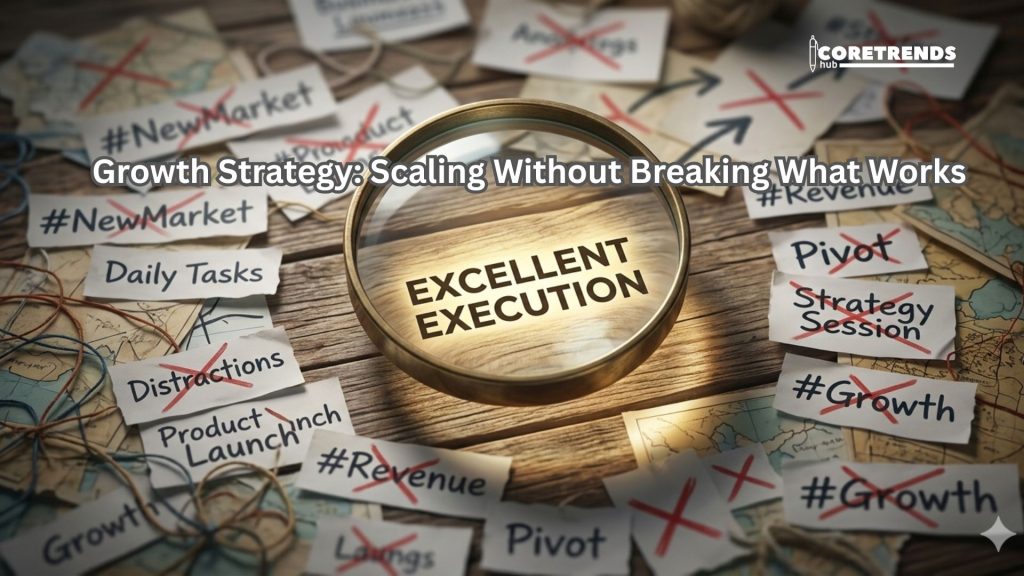
Growth Strategy: Scaling Without Breaking What Works
Growth sounds universally positive until you experience the pain of growing too fast, too chaotically, or in directions that dilute what made you successful initially. Strategic growth means expanding deliberately in ways that leverage and strengthen your core capabilities rather than stretching them beyond recognition. The first growth question isn’t “how fast can we grow?” but “what kind of growth builds the business we want to become?” Revenue growth that destroys profitability, expands into markets where you can’t compete effectively, or requires capabilities you don’t have and can’t build, isn’t strategic growth—it’s costly distraction disguised as progress. Market penetration—growing share in your existing markets with your existing offerings—often provides the most attractive growth opportunity yet gets overlooked in the search for more exciting expansion horizons. Before chasing new markets or developing new products, ensure you’ve maximized the opportunity where you’re already strong, already known, and already have competitive advantage. This typically requires confronting the uncomfortable truth that execution quality matters more than strategy creativity. Once you’ve genuinely saturated your core market, strategic growth comes through market development, product development, or diversification—each with different risk profiles and capability requirements. Market development takes your existing offering to new customer segments or geographies, leveraging product strength while learning new market dynamics. Product development creates new offerings for existing customers, leveraging customer relationships while developing new capabilities. Diversification—new products for new markets—is the highest risk option that should only be pursued when you have strong strategic reasons and sufficient resources to absorb inevitable learning costs. The businesses that grow sustainably build what Jim Collins calls the “flywheel”—a self-reinforcing loop where success in one area builds momentum enabling success in the next, creating competitive advantages that compound over time rather than spreading resources so thinly that nothing achieves critical mass.
Competitive Advantage in the AI Economy
Artificial intelligence is rewriting the rules of competitive advantage across every industry, making some historical advantages obsolete while creating entirely new sources of differentiation. The businesses that will dominate the next decade are those figuring out how AI transforms not just their operations, but the fundamental basis of competition in their markets. AI commoditizes some advantages that previously required years to build. Customer service quality that once demanded training hundreds of human representatives can now be delivered by AI systems that learn continuously and scale infinitely. Data analysis that required teams of specialists is now accessible through natural language queries to AI assistants. Creative work from writing to design that took hours now happens in seconds. This commoditization forces rethinking what actually creates sustainable differentiation. Yet AI simultaneously creates new advantage opportunities. The companies that will win are those that combine AI capabilities with uniquely human elements that AI cannot replicate—deep customer relationships built on trust and empathy, creative judgment about which problems are worth solving, ethical frameworks that guide how technology should be used, and organizational cultures that attract talent wanting to do meaningful work. Your competitive advantage in 2026 likely comes from how you deploy AI to amplify human judgment rather than replace it, how you use AI to create customer experiences that competitors cannot easily copy, and how you build data and learning loops that make your AI systems progressively smarter through use. The strategic question isn’t whether to adopt AI—that decision has been made for you by competitive reality—but how to deploy it in ways that strengthen rather than undermine your core differentiators. Companies like McKinsey research indicates are creating competitive moats by using AI to personalize customer experiences at scale, optimize operations in real-time, and accelerate innovation cycles—advantages that compound over time as their systems learn and improve continuously.
Scenario Planning for Navigating Uncertainty
The future isn’t knowable, but it also isn’t random. Scenario planning develops strategic flexibility by preparing for multiple possible futures rather than betting everything on a single prediction. This discipline proves invaluable in volatile times when the range of plausible outcomes has widened dramatically. Effective scenario planning identifies the critical uncertainties that could fundamentally reshape your business environment—the things you don’t know that really matter. These aren’t risks you can calculate probability distributions for; they’re genuine uncertainties where multiple divergent futures remain plausible. For a retail business, critical uncertainties might include the speed of e-commerce adoption, regulatory changes around data privacy, or the stability of supply chains. For each critical uncertainty, develop two to four divergent scenarios representing different ways the future could unfold. Name these scenarios memorably—”Golden Age,” “Slow Burn,” “Storm and Stress”—because named scenarios become thinking tools your organization can reference easily. For each scenario, work through the strategic implications: what would our industry look like, what would customers value, what would competitors do, and most critically, what capabilities would we need to succeed? This process reveals strategic moves that work across multiple scenarios—these become your core strategy. It also identifies contingency plans and early warning indicators that signal which scenario is actually unfolding, allowing you to adapt before it’s crisis time. The real value isn’t predicting the future correctly but building the organizational muscle to think strategically about uncertainty and respond flexibly as clarity emerges. Companies that excel at scenario planning don’t get paralyzed by uncertainty; they maintain strategic confidence while remaining tactically adaptive as the future unfolds.
Aligning Culture with Strategy for Sustainable Success
Culture eats strategy for breakfast—Peter Drucker’s famous observation—because even the most brilliant strategy fails if the organization’s culture actively works against it. Yet culture isn’t some nebulous, unchangeable characteristic you inherit. Culture is the sum of behaviors your organization rewards, tolerates, and punishes, and therefore can be deliberately shaped to support strategic objectives. The businesses that align culture with strategy start by defining the specific behaviors critical for executing their strategy. If your strategy depends on innovation, what specific behaviors demonstrate innovation in practice? Experimenting with new approaches even when success isn’t guaranteed? Sharing failures so others learn? Collaborating across silos? These concrete behaviors become what you hire for, train in, measure, and most importantly, reward through promotions, bonuses, and public recognition. Conversely, you must identify and eliminate behaviors that undermine strategy regardless of how culturally entrenched they might be. If collaboration is strategic but internal competition dominates, you have to change incentive systems that pit teams against each other. If speed matters but consensus-seeking delays every decision, you need to clarify decision rights and authority. The hardest cultural work involves confronting sacred cows—”we’ve always done it this way” practices that everyone knows conflict with strategic direction but that politically powerful factions protect. Leaders demonstrate cultural commitment not through speeches about values but through the daily choices they make about what behavior gets rewarded and what gets called out. When the top salesperson who hits every number but treats colleagues terribly finally faces consequences, everyone learns what the culture truly values. When resources get redirected from a profitable legacy business to a strategic growth initiative, the organization understands strategic commitment is real. Culture change happens slowly through countless small consistent signals, not through dramatic one-time interventions or inspirational posters in the break room.
Measuring What Matters: KPIs That Drive Performance
What gets measured gets managed—but measuring the wrong things manages you into failure. The art of strategic measurement lies in identifying the key performance indicators that actually predict strategic success rather than merely documenting past activity. Financial metrics like revenue and profit are essential but lagging—they tell you how you did, not whether current actions are building future success. Leading indicators that predict future performance are where strategic measurement creates real value. Customer metrics like Net Promoter Score, customer lifetime value, and repeat purchase rates predict future revenue more reliably than last quarter’s sales figures. Operational metrics like cycle times, quality rates, and capacity utilization predict whether you can deliver on your strategic promises consistently. Learning metrics like employee capability development, innovation pipeline strength, and strategic initiative completion rates predict whether you’re building the organization your strategy requires. The trap many businesses fall into is measuring everything easily measured rather than figuring out how to measure what truly matters. If customer lifetime value is strategic but hard to calculate, the answer isn’t defaulting to simple metrics like website traffic; it’s investing in the analytical capability to measure what matters. Equally important as choosing the right metrics is having the discipline to review them regularly and actually change behavior based on what you learn. Too many KPI dashboards become wallpaper—numbers that get reported but never drive decisions or action. Strategic measurement works when the executive team reviews metrics together regularly, debates what they mean, and adjusts strategy and resource allocation based on what the data reveals. This requires creating psychological safety where negative trends can be discussed honestly as learning opportunities rather than triggering blame and defensiveness that encourages data manipulation or willful blindness.
The Strategic Leader’s Most Important Job
Strategic leadership isn’t about being the smartest person in the room or having all the answers—it’s about creating the conditions where your organization can develop and execute winning strategies collaboratively. The strategic leader’s most important job is allocating attention, the scarcest resource in any organization. What you pay attention to signals what matters, and where leaders focus their attention, organizations follow. If your leadership team spends ninety percent of their time on operational firefighting and ten percent on strategic work, that ratio telegraphs organizational priorities more clearly than any strategy document. Strategic leaders protect time for strategic work despite the gravitational pull of urgent operational demands. They create forums where strategic conversations happen with structure and discipline—not just annual planning retreats but quarterly strategy reviews, monthly deep dives on strategic initiatives, and weekly executive team discussions of strategic decisions and trade-offs. They ask strategic questions consistently: Does this align with our strategy? What are we learning about whether our strategy is working? What’s changing in our environment that should cause us to rethink our assumptions? They champion strategic discipline, saying no to attractive opportunities that don’t fit strategic priorities, even when that requires disappointing powerful stakeholders or walking away from revenue. Strategic leadership also means building the strategic capability of your team rather than being the sole strategic thinker. This requires teaching strategic frameworks, involving broader groups in strategic discussions, and pushing strategic decision-making down to the level where the best information exists. The goal is building an organization where strategic thinking permeates every level, where frontline employees understand how their daily decisions connect to strategic objectives, and where strategy becomes something everyone does rather than something done to them by executives.
Strategic Transformation: When Everything Needs to Change
Sometimes incremental strategic adjustment isn’t enough—the entire business model, organizational structure, or core capabilities need fundamental transformation. Digital transformation, sustainability transformation, culture transformation—these aren’t just buzzwords but real strategic imperatives that require changing everything about how your organization operates. Strategic transformation is brutally difficult because it requires running today’s business profitably while simultaneously building tomorrow’s completely different business. This ambidexterity challenges organizations at every level. Leaders must allocate resources between sustaining current operations and building future capabilities. Teams must maintain current performance standards while learning entirely new ways of working. Individuals must let go of expertise that made them successful to develop new capabilities the organization needs. The change management industry has overcomplicated transformation, but the fundamentals remain straightforward if not easy: create compelling urgency that makes the status quo unacceptable, paint a clear vision of where you’re going that people can understand and get excited about, remove obstacles preventing people from acting on the vision, generate short-term wins that build credibility and momentum, and embed new approaches into organizational culture so they stick after the initial transformation energy fades. What makes transformation strategic rather than just operational change is maintaining clear direction through the inevitable chaos. When everything feels uncertain and chaotic, people need to know what isn’t changing—the core purpose, values, and strategic direction that anchor the organization even as tactics and structures transform. Transformation fails most often not because people resist change but because leaders fail to provide sufficient clarity, support, and role modeling of the new behaviors they’re asking everyone to adopt.
Building Your Strategic Management Practice
Strategic management isn’t a project with an end date but a discipline you practice continuously, refining your capability over time like any other professional skill. Start by establishing the rhythms and rituals that make strategic work happen consistently rather than sporadically. Annual strategic planning provides the big picture, quarterly strategy reviews assess progress and adjust direction, monthly deep dives explore specific strategic questions in depth, and weekly executive team meetings handle strategic decisions and trade-offs. These aren’t bureaucratic requirements but the scaffolding that ensures strategic work happens despite operational pressures. Invest in developing your team’s strategic thinking capabilities through training, exposure to frameworks and case studies, involvement in real strategic decisions, and coaching that helps them think more strategically about their own areas. Build external networks that provide diverse perspectives—advisory boards, peer CEO groups, industry associations, and consultants who bring experience from other contexts. Read strategically, following thinkers and practitioners working at the frontier of strategic management practice. Document what you learn—not just the formal strategy documents but the strategic decisions you make, the reasoning behind them, and what you learn about whether they worked. This strategic memory prevents repeating mistakes and allows building on what works. Most importantly, grant yourself permission to adjust course when evidence suggests your strategy isn’t working. Persistence is valuable, but persisting with a failing strategy is foolish. The distinction between appropriate persistence and stubborn foolishness is whether you’re learning and adapting or just hoping things improve on their own.
The Strategic Imperative for 2026 and Beyond
We’re living through a period of discontinuous change where historical patterns provide unreliable guidance for future success. The businesses that will thrive in this environment are those that master strategic management—not as an annual planning exercise but as a continuous discipline that guides every decision and action. This requires courage to make real choices that involve trade-offs and saying no to attractive opportunities that don’t fit your strategy. It requires discipline to stay focused on strategic priorities when shiny new possibilities constantly tempt you in different directions. It requires humility to acknowledge what you don’t know and what isn’t working, adjusting course based on evidence rather than ego. And it requires building organizations where strategic thinking isn’t the exclusive domain of executives but a capability that permeates every level, enabling the distributed decision-making that allows businesses to move with the speed that markets now demand. The competitive advantages of the future will belong to organizations that combine the clarity of strategic direction with the flexibility of tactical adaptation—knowing where they’re going while remaining open to learning better paths to get there. This is strategic management not as business theory but as the practical discipline that separates thriving businesses from struggling ones, intentional growth from accidental stagnation, and organizations that shape their futures from those swept along by forces they never understood or attempted to influence.
Dive Deeper into Strategic Excellence
This guide provides the foundation for strategic management, but mastery comes from going deeper into each critical element. Explore our comprehensive cluster articles that examine specific strategic disciplines in detail:
Strategic Frameworks & Planning: Learn how to apply proven strategic frameworks that work in 2026’s complex business environment in our guide to Strategic Management in 2026: Frameworks That Work.
Building Winning Strategy: Discover the step-by-step process for developing strategy that creates real competitive advantage in How to Build a Winning Business Strategy.
Execution Excellence: Bridge the strategy-execution gap with practical approaches in Execution Excellence: Turning Vision into Results.
Growth Strategy: Navigate the challenges of scaling without breaking what works in Growth Strategy for Scaling Companies.
AI-Era Competition: Understand how to build sustainable competitive advantage when AI reshapes industry dynamics in Competitive Advantage in the AI Economy.
Scenario Planning: Develop strategic flexibility for uncertain times through Scenario Planning for Volatile Markets.
Culture Alignment: Learn to shape organizational culture that reinforces rather than undermines strategy in How to Align Culture with Strategy.
Strategic Measurement: Identify and track the metrics that actually predict and drive strategic success in KPIs That Actually Drive Performance.
Each article provides deep practical guidance on these critical strategic capabilities, with frameworks, examples, and actionable steps you can implement immediately.
Conclusion
Strategic management is the difference between being deliberately excellent and accidentally mediocre. It’s choosing who you are and who you serve rather than trying to be everything to everyone. It’s building capabilities that compound over time rather than chasing whatever seems urgent today. It’s creating organizations where strategy guides thousands of daily decisions rather than sitting in documents nobody reads. The businesses that dominate their markets in 2026 didn’t arrive there by accident or through superior luck—they got there through superior strategic management that allowed them to see opportunities others missed, make choices others couldn’t make, build capabilities others didn’t prioritize, and execute with consistency others couldn’t maintain. This strategic capability becomes more valuable, not less, as change accelerates and uncertainty deepens. The future belongs to strategically managed organizations led by people who understand that working hard in the wrong direction is worse than not working at all, that being busy isn’t the same as being effective, and that the clearest path to success is making deliberate strategic choices and following through with disciplined execution. Your competitive advantage isn’t just what you do differently—it’s how you think strategically, decide deliberately, and execute consistently over time. That’s the essence of strategic management, and in 2026, it’s the foundation of every business that thrives rather than merely survives.
FAQ
Q1: How often should we update our business strategy?
Your core strategy—where you compete, how you win, and what capabilities you’re building—should remain relatively stable for 3-5 years unless fundamental market conditions change dramatically. However, tactics and approaches should be reviewed quarterly and adjusted based on what you’re learning. Annual strategy reviews assess whether core strategic choices remain valid given environmental changes, but frequent major strategy pivots usually signal poor initial strategy rather than appropriate adaptation. The goal is stability in direction with flexibility in approach.
Q2: What’s the difference between strategy and planning?
Strategy is about making choices regarding where to compete and how to win—it’s fundamentally about deciding what you will and won’t do. Planning is about organizing the resources, timelines, and actions needed to execute those strategic choices. You can plan without strategy, but it’s just organizing activities without clear direction. You can have strategy without detailed plans, but execution suffers. Effective strategic management requires both—clear strategic choices and disciplined planning to make them real.
Q3: How do small businesses compete strategically against larger competitors?
Small businesses win through focus and agility rather than trying to match large competitors’ resources or breadth. Choose narrow market segments where you can be genuinely differentiated and build deep customer relationships that larger competitors can’t replicate. Move faster than large competitors, adapting to market changes and customer needs with speed that bureaucracy prevents in larger organizations. Often your advantage is being able to say no to opportunities that don’t fit, maintaining focus that diversified competitors can’t match.
Q4: Can strategy work in highly unpredictable markets?
Strategy becomes more valuable, not less, in unpredictable markets because it provides direction when everything else feels chaotic. However, the type of strategy appropriate for unpredictable markets differs from stable environments. Focus on building adaptive capabilities rather than detailed long-term plans, create options that preserve flexibility, and develop early warning systems that help you detect change quickly. The strategy is maintaining strategic clarity about core identity and purpose while remaining tactically flexible about how you achieve your objectives.
Q5: How do I know if my current strategy is working?
Define success metrics when you set strategy—leading indicators that predict whether your strategy is creating the outcomes you intended. Review these metrics systematically, looking for trends over multiple quarters rather than reacting to single data points. Ask whether you’re gaining rather than losing ground against competitors, whether strategic initiatives are completing on schedule and delivering expected benefits, and whether organizational capabilities are developing as planned. Most importantly, are you having to work harder to achieve the same results, suggesting your strategy is fighting market reality rather than leveraging market forces?
Q6: What role does innovation play in strategic management?
Innovation should be strategic—directed toward strengthening your competitive position rather than just creating novel features or products. Strategic innovation focuses on the capabilities, business models, and customer experiences that deepen your competitive advantages or open new sources of advantage. Random innovation without strategic direction wastes resources on things customers don’t value or that competitors easily copy. The question isn’t “can we innovate here?” but “does innovation in this area strengthen our strategic position enough to justify the investment?”