
The business landscape has transformed dramatically with artificial intelligence taking center stage in operational efficiency. ChatGPT, OpenAI’s revolutionary conversational AI, has evolved from a simple chatbot into a powerful business automation tool that’s reshaping how companies operate in 2026. Whether you’re a solopreneur managing multiple tasks or a enterprise looking to streamline workflows, ChatGPT offers unprecedented opportunities to automate repetitive processes, enhance customer experiences, and boost productivity. This comprehensive guide will walk you through practical strategies to leverage ChatGPT for business automation, helping you save time, reduce costs, and scale your operations effectively. You’ll discover actionable insights, real-world applications, and step-by-step implementation methods that can transform your business today.
Table of Contents
Understanding ChatGPT’s Business Automation Capabilities
ChatGPT has matured significantly since its initial release, now offering advanced features specifically designed for business environments. The latest iterations include enhanced API integrations, custom GPT models, and enterprise-grade security protocols that make it suitable for sensitive business operations. What sets ChatGPT apart in 2026 is its ability to understand context, maintain conversation history, and execute complex multi-step tasks with minimal human intervention. Businesses can now train custom models on their specific data, creating AI assistants that understand company terminology, brand voice, and operational procedures. The platform supports over 80 languages, making it invaluable for global operations, and its reasoning capabilities have improved to handle nuanced business scenarios that previously required human judgment.
To fully leverage automation, companies must align it with proven modern business strategy frameworks.
Automating Customer Service and Support Operations
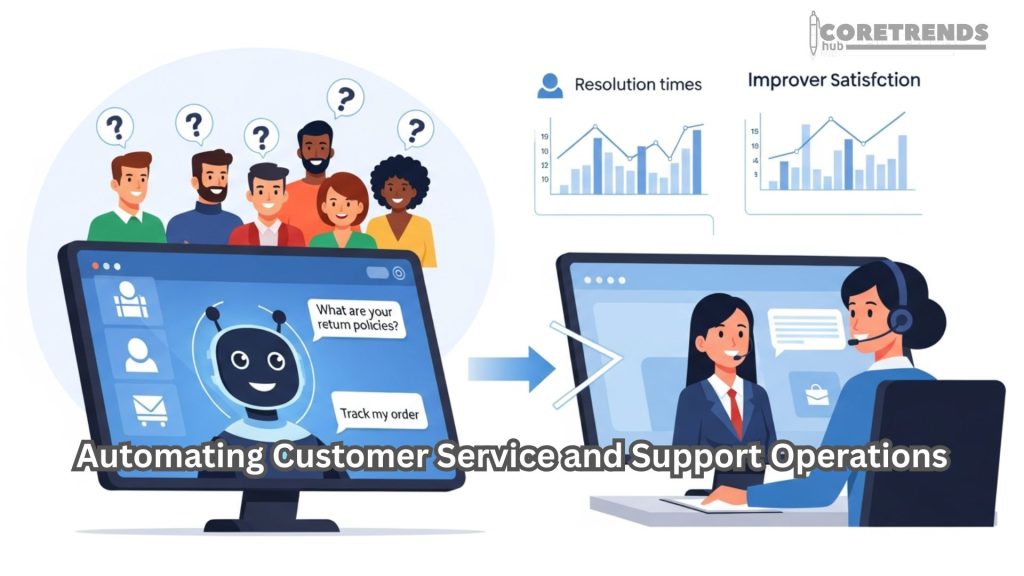
Customer service represents one of the most impactful areas where ChatGPT delivers immediate ROI for businesses. By implementing ChatGPT-powered chatbots on your website, social media platforms, and messaging apps, you can provide 24/7 support without expanding your human workforce. These AI assistants handle common inquiries about product specifications, order status, return policies, and troubleshooting steps with remarkable accuracy. The system can escalate complex issues to human agents while maintaining conversation context, ensuring seamless handoffs. Companies using ChatGPT for customer service report resolution times reduced by 60-70% and customer satisfaction scores improving by 40%. The key is training your ChatGPT model on your actual support tickets, FAQs, and product documentation to ensure responses align with your brand standards and accurately reflect your offerings.
Streamlining Content Creation and Marketing Workflows
Businesses today are heavily relying on advanced AI tools for marketing and content creation to stay competitive. Marketing teams are leveraging ChatGPT to automate content production across multiple channels while maintaining quality and consistency. The AI can generate blog post outlines, social media captions, email newsletters, product descriptions, and advertising copy in minutes rather than hours. What makes this particularly valuable is ChatGPT’s ability to adapt tone and style based on your brand guidelines and target audience. You can create content calendars, repurpose existing content into different formats, and even generate SEO-optimized meta descriptions and title tags automatically. However, the most sophisticated approach involves using ChatGPT as a collaborative tool rather than a replacement—having it generate first drafts that human marketers refine and personalize. Companies implementing this hybrid approach see content production increase by 300% while maintaining authenticity and strategic alignment with business objectives.
Creating Personalized Email Campaigns at Scale
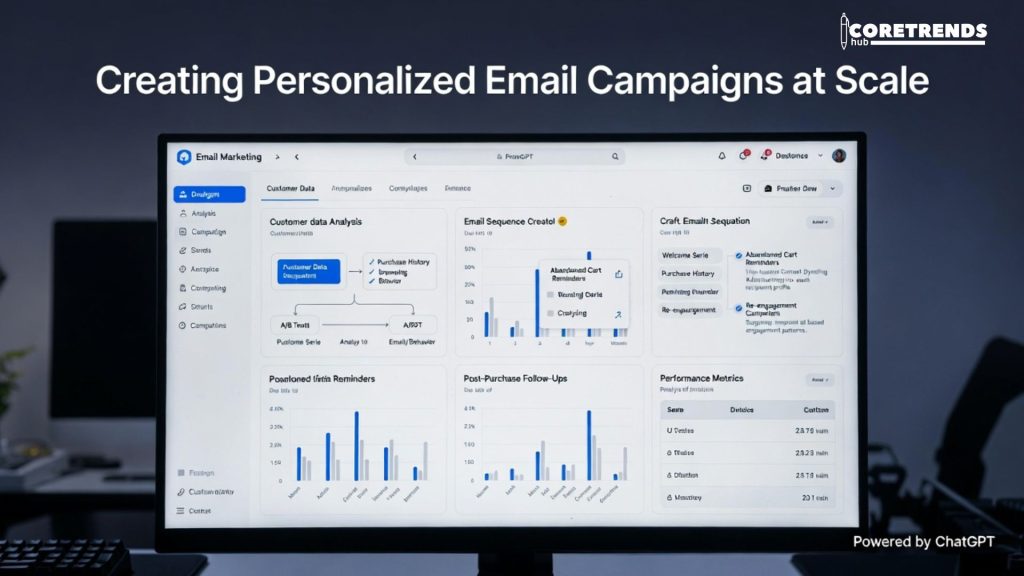
Email marketing automation reaches new heights when powered by ChatGPT’s natural language capabilities. The AI can analyze customer data, purchase history, and browsing behavior to craft personalized email sequences that feel genuinely individual rather than mass-produced. You can automate welcome series, abandoned cart reminders, post-purchase follow-ups, and re-engagement campaigns with dynamic content that adapts to each recipient’s profile. ChatGPT excels at A/B testing email variations, analyzing performance metrics, and suggesting improvements based on engagement patterns. This level of personalization previously required extensive marketing automation platforms and significant manual effort.
Generating Market Research and Competitive Analysis
ChatGPT can process vast amounts of market data, competitor information, and industry reports to generate comprehensive research summaries. By feeding it publicly available information about your market, the AI can identify trends, highlight opportunities, and flag potential threats to your business. This automation saves countless hours typically spent on manual research and report compilation.
Automating Sales Processes and Lead Qualification
Sales teams are experiencing dramatic productivity gains by automating lead qualification and initial outreach with ChatGPT. The AI can analyze incoming leads based on predefined criteria, score them according to conversion likelihood, and engage with prospects through personalized messaging. ChatGPT-powered sales assistants can handle initial discovery calls, answer product questions, schedule demonstrations, and even negotiate basic terms within established parameters. The system learns from successful sales conversations, continuously improving its approach and messaging. For B2B companies, ChatGPT can research prospects before meetings, generate customized proposals, and create follow-up sequences that nurture relationships over time. Sales representatives report spending 50% less time on administrative tasks and 50% more time on high-value relationship building when ChatGPT handles routine interactions.
Enhancing Internal Operations and Employee Productivity
Beyond customer-facing applications, ChatGPT revolutionizes internal business operations by serving as an intelligent assistant for employees across departments. HR teams use it to automate onboarding processes, answer policy questions, and screen initial job applications based on specific criteria. Finance departments leverage ChatGPT to generate expense reports, explain budget variances, and provide real-time answers to accounting questions. IT support benefits enormously from ChatGPT handling tier-one support tickets, password resets, and common troubleshooting procedures. The AI acts as an institutional knowledge repository, making information accessible instantly rather than buried in documentation or dependent on specific employees. This democratization of knowledge significantly reduces the learning curve for new team members and ensures consistent information across the organization.
Automating Meeting Summaries and Action Items
ChatGPT can process meeting transcripts to automatically generate summaries, extract action items, and assign tasks to team members. This eliminates the traditional burden of manual note-taking and ensures nothing falls through the cracks. The AI can even send personalized follow-up emails to participants with their specific action items and deadlines.
Implementing ChatGPT API for Custom Business Solutions
The ChatGPT API enables developers to build custom automation solutions tailored to specific business needs. Companies are integrating the API into their existing software systems, CRM platforms, inventory management tools, and proprietary applications to add intelligent automation layers. The API allows for real-time data processing, enabling ChatGPT to access current information from your databases when responding to queries or executing tasks. For example, an e-commerce business might integrate ChatGPT with their inventory system to automatically notify customers about product availability, suggest alternatives for out-of-stock items, and predict restock dates. The API’s flexibility means you can automate virtually any text-based business process, from generating legal contract clauses to creating financial forecasts based on historical data. Implementation costs have decreased significantly in 2026, making enterprise-grade AI automation accessible even to small businesses.
If you want to build digital solutions quickly, explore modern no-code app development platforms.

Data Security and Compliance Considerations
When automating business processes with ChatGPT, security and compliance must be prioritized to protect sensitive information and meet regulatory requirements. OpenAI offers enterprise solutions with enhanced security features including data encryption, private cloud deployments, and compliance certifications for industries like healthcare and finance. Businesses must establish clear protocols about what information can be processed through ChatGPT and implement access controls to prevent unauthorized data exposure. For companies handling GDPR-regulated data, configuring ChatGPT to anonymize personal information before processing is essential. Regular security audits, employee training on proper AI usage, and incident response plans should be standard practice. The good news is that ChatGPT’s enterprise offerings in 2026 include built-in compliance frameworks for major regulations, making it easier to automate while remaining compliant with industry standards.
Measuring ROI and Optimizing Automation Performance
Successful ChatGPT implementation requires ongoing measurement and optimization to maximize return on investment. Establish clear KPIs before deployment, such as time saved per employee, customer satisfaction scores, lead conversion rates, or content production volume. Most businesses track both quantitative metrics (response times, task completion rates, cost savings) and qualitative indicators (customer feedback, employee satisfaction, output quality). ChatGPT’s performance improves through continuous training on your specific use cases and feedback loops where users rate response quality. Analytics dashboards should monitor AI accuracy, identify common failure points, and highlight opportunities for expanded automation. Companies achieving the highest ROI treat ChatGPT implementation as an iterative process, starting with high-impact, low-complexity tasks and gradually expanding to more sophisticated applications as they build expertise and confidence.
Conclusion
ChatGPT represents a transformative opportunity for businesses to automate operations, enhance productivity, and compete more effectively in 2026’s fast-paced marketplace. From customer service and marketing to sales and internal operations, the applications are virtually limitless for companies willing to embrace AI-powered automation. The key to success lies in strategic implementation—starting with clear objectives, choosing high-impact use cases, and maintaining the human oversight necessary to ensure quality and alignment with business values. As ChatGPT continues evolving with more advanced capabilities, early adopters who develop AI automation expertise now will have significant competitive advantages. The future of business isn’t about replacing humans with AI, but rather augmenting human capabilities with intelligent automation that handles repetitive tasks while freeing people to focus on creativity, strategy, and relationship building.
FAQ
Q1: How much does it cost to implement ChatGPT for business automation?
Costs vary significantly based on usage volume and implementation complexity. ChatGPT API pricing in 2026 starts around $0.002 per 1,000 tokens for basic models, with enterprise solutions ranging from $500 to $5,000+ monthly depending on scale. Small businesses can start with pre-built solutions for under $100 monthly, while custom integrations may require $5,000-$50,000 in development costs. Most companies see ROI within 3-6 months through labor savings and efficiency gains.
Q2: Can ChatGPT handle industry-specific terminology and processes?
Yes, ChatGPT can be fine-tuned on industry-specific datasets to understand specialized terminology, regulations, and workflows. Whether you’re in legal, healthcare, manufacturing, or any other sector, the AI can be trained on your documentation, past communications, and domain knowledge to provide contextually appropriate responses. Custom GPT models in 2026 offer sophisticated industry adaptation capabilities.
Q3: What are the biggest risks of using ChatGPT for business automation?
Primary risks include data privacy concerns, potential for inaccurate information (hallucinations), over-reliance on AI without human oversight, and compliance violations if improperly configured. Mitigate these through proper security protocols, human review processes for critical decisions, employee training, and starting with low-risk applications before expanding to sensitive areas.
Q4: How long does it take to implement ChatGPT automation in a business?
Implementation timelines range from days to months depending on complexity. Simple chatbot deployments can be operational within 1-2 weeks, while comprehensive automation across multiple departments might take 3-6 months. The key is phased implementation—starting with one high-impact area, measuring results, and expanding based on success.
Q5: Will ChatGPT automation replace human employees?
ChatGPT is best viewed as an augmentation tool rather than a replacement. While it automates repetitive, time-consuming tasks, it creates opportunities for employees to focus on higher-value work requiring creativity, emotional intelligence, and strategic thinking. Most successful implementations redeploy human talent to more meaningful roles rather than reducing headcount.
Q6: Can ChatGPT integrate with existing business software and tools?
Yes, ChatGPT API can integrate with most modern business software including CRM systems (Salesforce, HubSpot), project management tools (Asana, Monday), communication platforms (Slack, Microsoft Teams), and custom applications. Integration complexity depends on your existing tech stack, but most major platforms now offer native ChatGPT integrations or straightforward API connections.